We are here
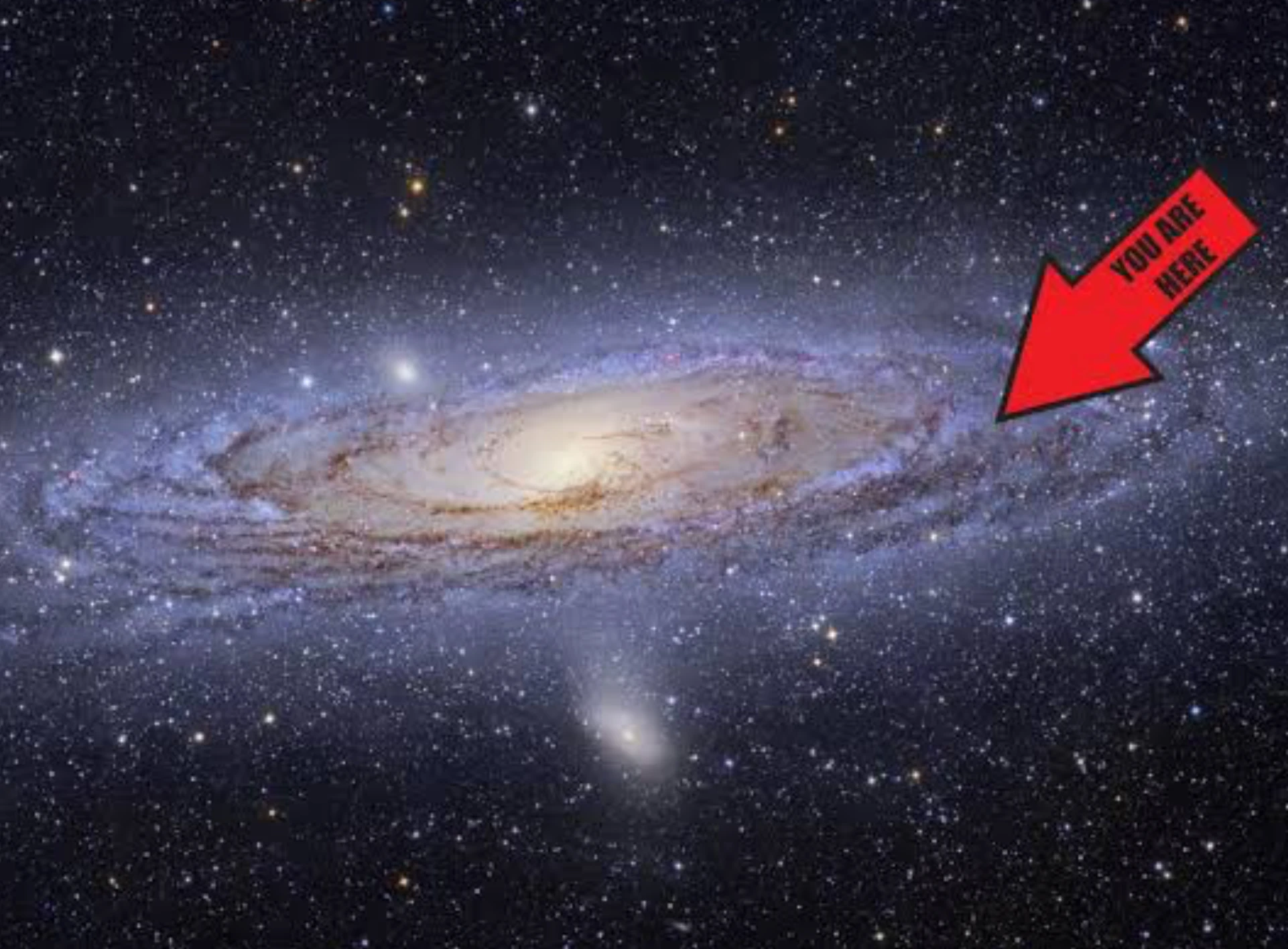
If you read the Hitchhiker's Guide, you may remember what a Total Perspective Vortex is. When a victim is placed inside the chamber, they are given a brief, absolute glimpse of the entire, unimaginable infinity of creation. Somewhere inside that massive cosmic map is a tiny, microscopic dot with an arrow pointing to it that says: "You are here." It causes utter destruction to the person, not because the person doesn't know that the cosmos is vast, but rather, because they don't want to be reminded of it. Adams’ own moral is that life can’t afford "a sense of proportion".
Similarly, we know at least on an intellectual level, that the collective knowledge of the human race is incomprehensibly immense. But we also accept that we are incapable of leveraging all of it (or even a meaningful fraction of it) at any one time. Our brain then chooses to conveniently ignore this fact so we can get on with our lives. We feel pretty satisfied with what we know as researchers when we publish a paper in a nice journal and get some nice comments. The arrival and the rapid advancement of LLMs, to me, shatters that illusion. I mean, this isn't the first time technological advancements have made doing research more efficient. We got the internet, Google Scholar came along, YouTube explained my paper better than I could. But this feels different. This feels like the opening of floodgates. This was supposed to be science fiction a couple of years ago. Now an AI agent like Jarvis (from Iron Man) is reality.
For the past year, slowly but surely, I have been integrating Claude more and more into my daily workflow. Looking back at it, Claude really entered my work-life during a transition. A cataclysmic transition if I were more dramatic about it. Summer of 2025, we received a federal grant at the tail-end of my time at Houston. It was an algorithm-heavy robotics kind of project. To a large extent, it was a synthesis of a number of distinct algorithms and surprisingly well-suited for LLM coding. It was also a project of short duration (2 years overall), happening at a time when my students were transitioning as well, and wouldn't have the bandwidth to take on something entirely different (i.e., no mechanics and a lot of serious programming).
So ChatGPT (at the time) was a natural tool to use. I started with chatting, and we would send code to each other back and forth, and I understood most of it at least conversationally. Then Claude and Claude Code entered the picture and the code base it developed became a black box to me. As complexity grew, I lost track of the features that were implemented and the algorithms or methods that were actually used. I kept on having to ask "where is this?" and "why is this here?" and get a half-satisfying answer before I plowed on. At this point, there is no hope of me understanding the code well enough to "manually" make changes. Yet, with the trust (or blind faith) I place in Claude, we demonstrated the codebase physically and it did work. Everyone was happy and life went on.
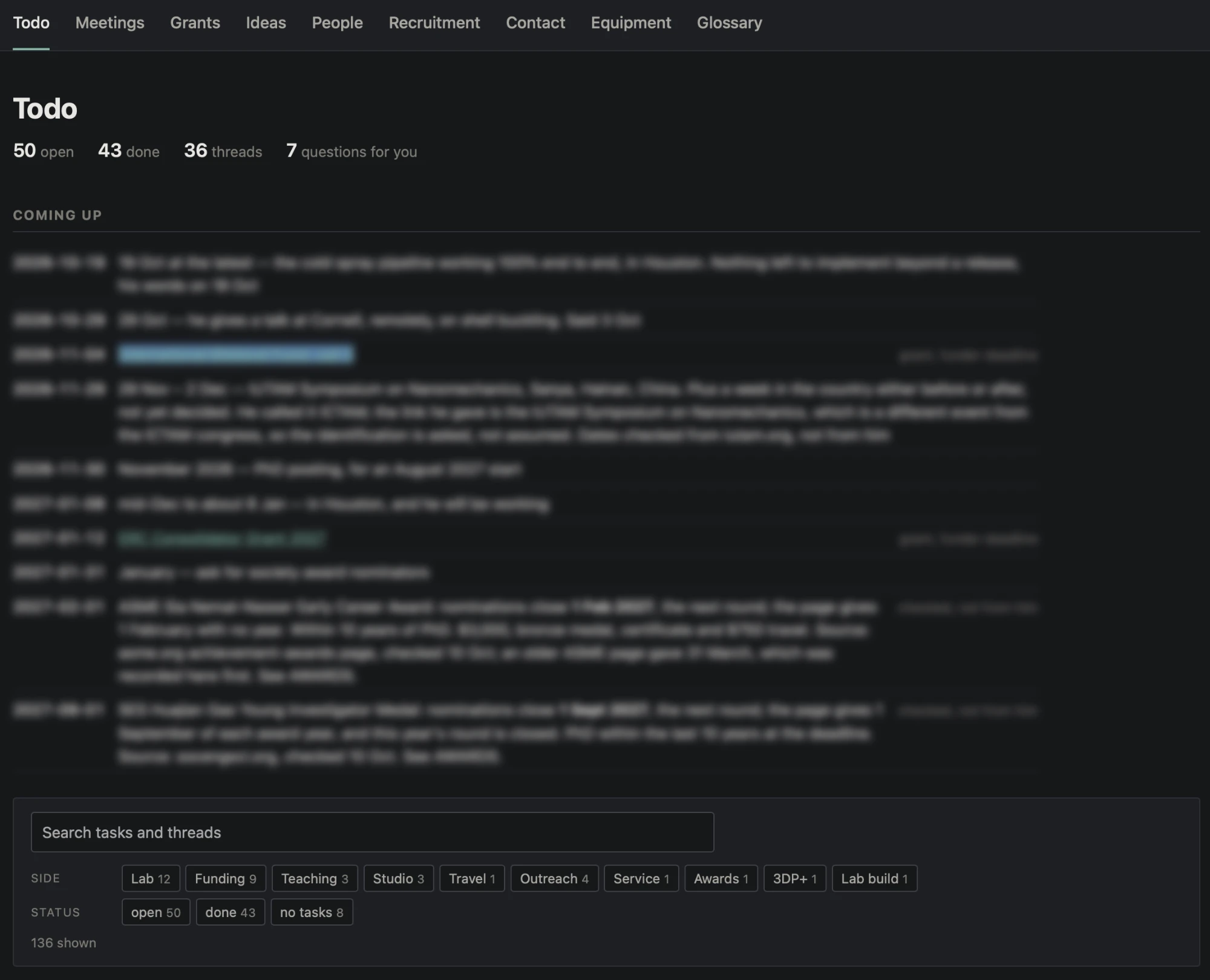
Since that time, I have been running Claude on so many projects that I had Claude code a personal app to keep track of it all. You can see a screenshot of it below. This personal blog is coded with Claude, and my lab website as well to a large extent. With these tools, I have no objections or qualms about the use of AI. In a sense, so long as they work, I don't really need to know how they work. (Something of node.js is involved?) However, there are other points where I have a nagging unease.
With the research projects I am working on, as I am starting a new lab and am a bit short on human-power, I am in essence treating Claude as a team of brilliant and inexhaustible grad students. Instead of weekly updates, Claude provides results in minutes and hours, and we iterate many times throughout a day. While it is sometimes too eager to do things (running through hours of simulations) and not capable (or willing) enough to analyze, with gentle nudging, I'd say it can carry on a research project (at least computational or analytical ones) competently.
I have reservations about doing this, and it causes me quite some anxiety. Let's start with the reservations. A large part of my job is to train future scientists in the hope that they will discover something amazing and wondrous. Now, at best, I am training the next iteration of LLMs, or (and I'm not being facetious) I am training students in how to use LLMs effectively. Conversely, with students, I expect mistakes. Students aren't usually good at obfuscating these mistakes. So in my conversations with students, the mistakes surface in a glaringly obvious manner. Students by-and-large aren't dishonest so I can at least trust what they say is true. It is difficult to detect deceit or dishonesty in AI. Students express uncertainty; their reluctance and hesitancy are a sign that the problem is getting hard. AI expresses total certainty even when it is demonstrably wrong. It doesn't know its own blind spots. These days I can still reason with it because each step in the thought process is still incremental. But it is already difficult to check over the procedure line by line. It is going to approach infeasible when it autonomously "thinks" for hours on end. It is all too easy to let go and become a conduit of AI results. How do I not confuse my actual capability with Claude-enhanced capability? Is this like using Google Scholar instead of going to the library for hours on end, or is it like I am out-sourcing my entire research enterprise to an off-shore organization and pretending I'm still running things?
Now comes the anxiety. I am not a theoretician. It takes me a great deal of effort and time to understand and develop theories. With Claude, the activation energy of this (more mathematical) approach becomes trivial. Zooming out to the larger issue of the Total Perspective Vortex, how do I deal with knowing that I have all this information and knowledge available? We (at least several folks I am close with) already experience imposter syndrome and nagging anxiety of inadequacy. Claude just deepened that pit exponentially. There are many problems I am curious about, but I knew (previously) that I didn't have the knowledge to address them. With AI, I feel like I have the capability. It is an illusion, but an alluring one. With every passing second I am not working with AI, I fear that I am missing out. When I am working with AI, I forget the mental exhaustion that comes with constantly learning new things. Claude can always dig deeper. What used to be a natural end-point is becoming blurred.
ChatGPT carpet bombed the entire field of mathematics. Our saving grace is the fact that in natural sciences and engineering, there is a need for physical evidence. Feynman famously said "It doesn't make any difference how beautiful your guess is; [...] if it disagrees with experiment, it’s wrong." As an experimentalist, I can still take comfort in the relatively embarrassing state of physical AI systems. I could start exploring "AI-for-physical-experiments" but should I? Is it for the benefit of humanity? After all, that is what we do science for. We are here now.